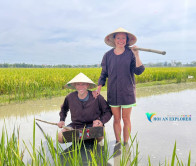
Hoi An Wet Rice Cultivation Process (From Seed Preparation to Planting)
The wet rice cultivation process in Hoi An follows traditional methods passed down for generations, combining careful preparation with skilled farming techniques.
Seed Selection & Sprouting – Farmers choose high-quality rice varieties, soak them in salt water to remove hollow grains, rinse, then soak and sprout until tiny white shoots appear.
See more details >>> Hoi An Wet Rice Growing Daily Tour Half Day Experience

Land Preparation – Fields are plowed, leveled, and flooded to create the perfect environment for rice growth.
Sowing Seedlings – Sprouted seeds are grown in nursery beds for about 20–25 days until they reach the right height for transplanting.
Transplanting – Young seedlings are carefully moved to the main field, spaced evenly for healthy growth.
Field Management – Farmers control water levels, fertilize, and protect crops from pests and diseases to ensure a good harvest.
This process blends traditional knowledge with practical farming skills, making Hoi An’s wet rice fields not just productive but also a living cultural heritage.

Seed Selection and Rice Sprouting (Preparing Seedlings)
This is a crucial first step since the quality of the seeds directly determines the yield and quality of the rice later on.
Selecting Seeds
Choosing rice varieties: Farmers usually select either purebred or hybrid rice varieties depending on the region. The seeds are carefully screened, removing hollow or broken grains.
Soaking in salt water: A 3–5% salt solution is used to separate solid grains (which sink) from hollow ones (which float).
Rinsing thoroughly: After discarding the hollow grains, the remaining seeds are rinsed with clean water to remove any salt residue, preventing it from affecting germination.
See more details >>> Hoi An Wet Rice Farming With Buffalos – A Unique Experience

Soaking the Seeds
The seeds are soaked for about 24–36 hours, depending on the rice variety.
The water is replaced every 6–8 hours to prevent fermentation and avoid suffocating the seeds.
When the grains start to crack open and reveal tiny white sprouts, they are ready for sprouting.
Sprouting the Seeds
Use cloth bags or straw to retain heat and keep the seeds in a dry, warm place.
Maintain a stable temperature of 28–32°C to ensure even sprouting.
Check the seeds every 6–8 hours and mist them lightly if they become dry.
After about 24–30 hours of sprouting, when the shoots reach 1–1.5 mm in length, the seeds are ready to be sown in the seedbed.

Land Preparation and Plowing
Preparing the field properly is essential for healthy root development and higher yields.
Clearing the Field
Remove weeds, plant residues, and other debris to create a clean environment for planting.
Plowing the Land
Farmers use plows or tractors to turn over the soil, helping to loosen it and improve aeration.
Plowing also mixes crop residues into the soil, increasing fertility.
Harrowing (Leveling the Field)
After plowing, the field is leveled to ensure uniform water distribution.
Proper leveling helps young rice plants grow evenly and prevents waterlogging in certain spots.

Sowing the Seedlings
Once the seeds have sprouted, they are sown in a nursery bed to grow into young seedlings before transplanting.
Preparing the Nursery Bed
The nursery bed should be fertile, well-drained, and level.
A thin layer of organic fertilizer or compost is added to improve soil quality.
Sowing the Seeds
Spread the sprouted seeds evenly across the bed.
Cover lightly with soil or straw to protect them from birds and insects.
Water the bed regularly to maintain moisture.
After 20–25 days, the seedlings will reach a height of 15–20 cm and will be ready for transplanting.
Transplanting the Rice Seedlings
Transplanting helps ensure stronger root development and better spacing for each plant.
Timing
Seedlings are usually transplanted 20–25 days after sowing.
The best time is early morning or late afternoon to avoid heat stress.
Spacing and Planting Method
The seedlings are transplanted into the field in rows, with a spacing of 20–25 cm between plants.
Usually, 2–3 seedlings are planted per hole to ensure proper growth.

Rice Field Management and Care
Proper care during the growing season ensures healthy plants and higher yields.
Water Management
Maintain a consistent water level of about 3–5 cm in the field.
Drain excess water before harvesting to improve grain quality.
Fertilization
Apply organic or chemical fertilizers in stages to provide essential nutrients.
Nitrogen, phosphorus, and potassium are the key elements needed for optimal growth.
Pest and Disease Control
Monitor the field regularly for insects, weeds, and diseases.
Use eco-friendly pesticides whenever possible to reduce environmental impact.
Harvesting (Optional Section if Needed)
When the grains turn golden yellow and the moisture content drops to about 20–25%, the rice is ready for harvesting.
Traditional methods involve hand-cutting with sickles.
Modern methods use mechanized harvesters for efficiency.


YOU MAY LIKE IT

Hoi An Wet Rice Farming With Buffalos – A Unique Experience
Rice is the main product of Vietnamese agriculture, especially in rural areas like Hoi An. Rice planting and harvesting is an indispensable part of the culture and life of the people here. To...